
CLMT5095G: Quantitative Methods in Climate Change and Public Health
- Course description
- Course learning objectives
- Photos of previous 2026 edition
- Shareable feedback from 2026 edition
Course description
Vergil link
This course provides an interdisciplinary introduction to the public health dimensions of climate change, with a focus on the mechanisms linking climate-related hazards to health outcomes, the methods used to study these relationships, and the policy and intervention frameworks that shape responses.
Students will examine major climate exposures—including hazardous heat stress, floods, tropical cyclones, air pollution, and other environmental stressors—and their impacts on population health, with particular attention to vulnerable communities, local and global inequities, and environmental justice.
The course emphasizes core epidemiologic and attribution methods used in climate–health research, alongside evaluation of public health adaptation and mitigation strategies. Students will also explore the role of global governance, international institutions, and financing mechanisms in addressing climate-related health risks.
Through lectures, applied examples, and student-led presentations, the course fosters systems thinking and critical analysis, equipping students from diverse disciplinary backgrounds to assess evidence, communicate uncertainty, and engage with real-world climate and health decision-making.
Course learning objectives
By the end of the course, students will be able to:
Describe and analyze the major climate-related hazards and detailed pathways through which climate change affects population health, with attention to vulnerability and inequities.
Apply and critically evaluate epidemiologic methods used to quantify climate–health relationships, including exposure assessment and sources of uncertainty.
Assess and compare public health adaptation and mitigation strategies, considering effectiveness, health co-benefits, and equity implications.
Explain the role of global and national governance structures, policies, and institutions in shaping climate–health responses.
Interpret and communicate climate–health attribution findings, including counterfactual reasoning and uncertainty, for public health and policy audiences.
Integrate environmental justice principles into the analysis of climate–health research, interventions, and policy decisions.
Photos of previous 2026 edition
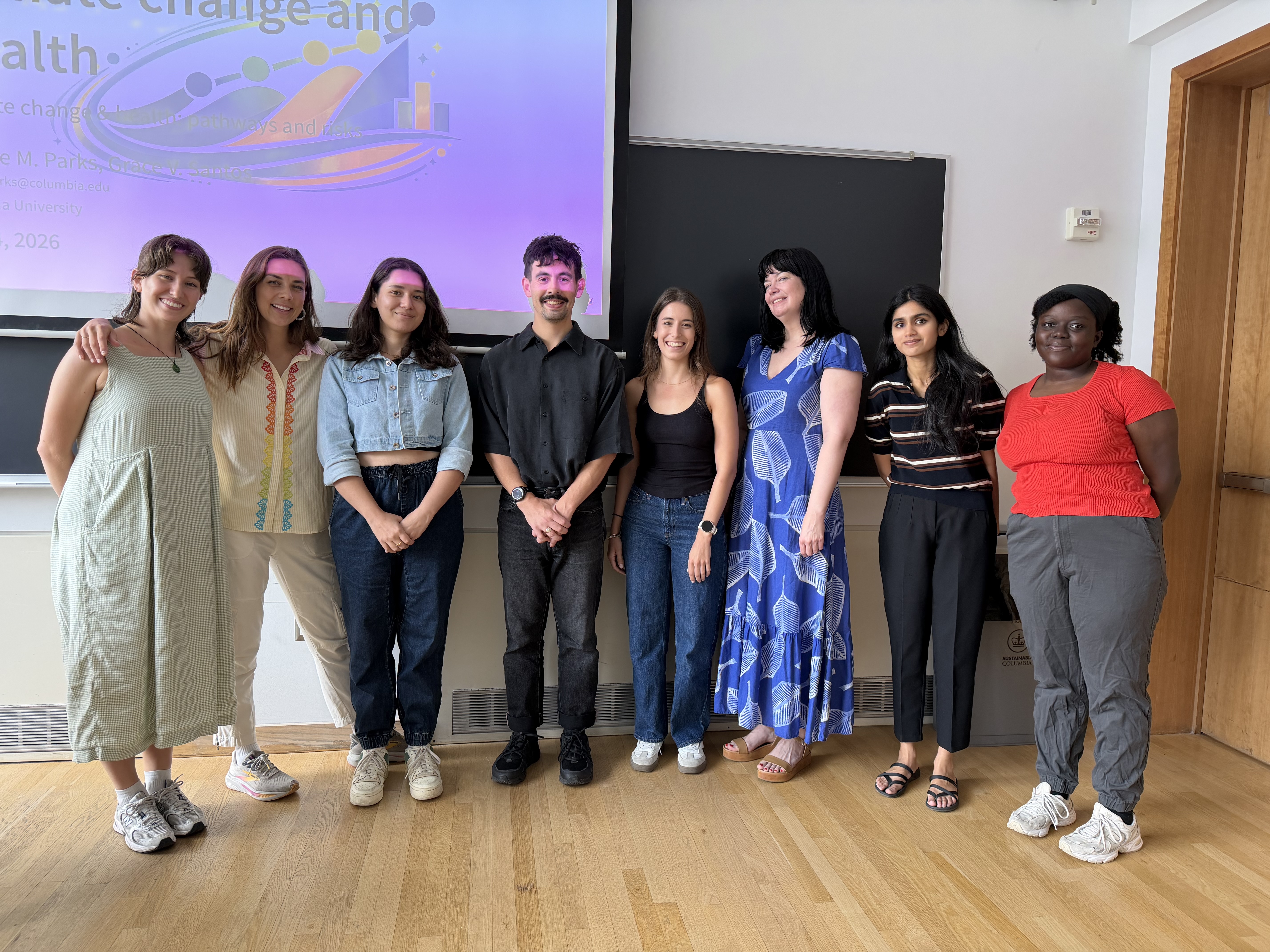
Shareable feedback from 2026 edition
"I had never taken a quantitative methods course, and I am very interested in climate change research, so I decided to take this course. My department at Teachers College, the Science Education department, is not currently offering a quants course, so many of us take a class elsewhere at Teachers College or at other schools within Columbia. I learned so much more in this course than I expected. I had no conception of how intertwined climate change is with public health policy, and the methods in which vital data is collected and analyzed in different models and graphs are not only interesting but have made me more literate in climate exposure and response."
"Great class. The assignments,. quizzes, and final presentation all made sense and was a fair way to learn and be evaluated. Prof is super smart and engaging, always allowing us to ask questions even if it brings us on a tangent."
"I have already shared this class with other Science Education PhD students who need to fulfill their quantitative methods requirement. I definitely still feel like a novice in the subject matter of the class; I learned so much in such a short period of time. The way the subject matter was presented helped me understand the material because we reviewed what we learned in the previous class period at the beginning of every class. I also found the quizzes to be really helpful because they held me accountable for my understanding of the course material and pointed out which concepts I need to learn more deeply. The article commentaries were rigorous and really forced me to truly understand the terms we learned in class in different contexts. They served as examples of real-life applications of the graphs and models we learned about in class lectures. I appreciated the check-ins throughout the course, as well, because I do well with consistent feedback on my work."
"I enjoyed Professor Parks because he really wanted us to understand the material of the class, and it showed. The discourse in the class gave opportunities for class participation and room to ask questions. I do my best in learning environments like this because it keeps me actively engaged."
"Prof Parks is so smart, plugged in, capable. It's very clear he is top of his field and knows so much about the topic. Great teacher."