
Overview
The R package gtropic provides a retrieval, filtering, and plotting client for the live G-TROPIC collection of tropical cyclone exposure datasets, published and updated weekly on Harvard Dataverse. Exposure datasets include wind, precipitation, and flooding data at second-level administrative unit (ADM2) resolution for every ADM2 and International Best Track Archive for Climate Stewardship (IBTrACS) recorded storm globally, from 1980 to the present. Key features include:
- A cornerstone query function:
gtropic_data() - Discovery helpers for exploring the available vocabulary of administrative units and storms
- Version manifests for reproducible re-retrieval
- An on-disk cache enabled by default, with per-call bypass controls
- Publication-ready static and interactive plots
STORM_ID is G-TROPIC’s unique, preferred storm key for queries, joins, grouping, and reproducible work. STORM_NAME is a convenient lookup and display label in Name-YYYY form; a complete value can still match multiple storms, including across basins, and YYYY is the published SEASON year rather than necessarily the genesis calendar year. Use gtropic_storms(STORM_NAME = ...) to inspect matches and find the intended STORM_ID, then use that ID in gtropic_data() and downstream analysis.
Explicit year and date filters select STORM_GENESIS_DATE_UTC. G-TROPIC’s annual storm metadata, wind, zero-pair, and track files—and the package’s temporal storm discovery and query organization—use that genesis calendar year.
Installation
The development version of gtropic can be installed from GitHub with:
# install.packages("pak")
pak::pak("sparklabnyc/gtropic")
gtropic can then be loaded and attached in your current R session as usual with:
Usage
library(gtropic)

# Quickly find Hurricane Katrina by its convenience label
katrina_matches <- gtropic_storms(STORM_NAME = "Katrina-2005")
katrina_matches
#> # A tibble: 1 × 4
#>   STORM_ID      STORM_NAME   USA_ATCF_ID STORM_GENESIS_DATE_UTC
#>   <chr>         <chr>        <chr>       <date>
#> 1 2005236N23285 Katrina-2005 AL122005    2005-08-23

# This example has one match; if several appear, choose the intended row
katrina_id <- katrina_matches$STORM_ID[[1]]
katrina <- gtropic_data(
  STORM_ID = katrina_id,
  date_range = c(2005, 2005)
)
#> Discovering datasets in collection "gtropic".
#> Downloading 'metadata/adm2.parquet'.
#> Downloading '02_wind/storm_metadata/2005.parquet'.
#> Retrieving 10 files (165.5 MB) ; .
#> Downloading '02_wind/exposures/2005.parquet'.
#> Downloading '02_wind/zero_pairs/2005.parquet'.
#> Downloading '04_precip/2005.parquet'.
#> Downloading '03_flood/2005.parquet'.
#> Downloading '01_pop/2005.parquet'.
#> Downloading '02_wind/storm_tracks/2005.parquet'.
#> Downloading 'metadata/codebook.json'.
#> Downloading 'metadata/adm2_geometry_simplified.parquet'.
summary(katrina)
#>
#> ── G-TROPIC data summary ───────────────────────────────────────────────────────
#>
#> ── Sources ──
#>
#> • Server: "dataverse.harvard.edu"
#> • Historical dataset: doi:10.7910/DVN/EAVWC3 v1.0
#> • Files retrieved: 10 (165.5 MB)
#> • Retrieved at: 2026-11-20 00:45:34 UTC
#>
#> ── Tables ──
#>
#> • wind: 1477 rows x 12 columns
#> • precip: 5908 rows x 3 columns
#> • flood: 237 rows x 7 columns
#> • zero_pairs: 39531 rows x 5 columns
#> • tracks: 64 rows x 10 columns
#> • pop: 1477 rows x 6 columns
#> • storm_metadata: 1 rows x 4 columns
#> • adm2: 1477 rows x 5 columns
#> • geometry: 1477 rows x 2 columns
#> • codebook: 7 entries (list)
#> • links: 1477 rows x 12 columns
#>
#> ── Resolved filters ──
#>
#> • ADM2 units: 1477
#> • Storms: 1
#> • Genesis window: 2005-01-01 to 2005-12-31
#> • Wind radius: 500 km
#> • Precipitation window: -2/ +1 days within 500 km
#> • Flood window: -2/+1 days within 500 km (match: "start")
#>
#> ── Warnings ──
#>
#> • precip_all_missing_adm2_ids: 86173395B10183828018242,
#> 86173395B33619167853359, 86173395B49833060083827, 86173395B5227574641069,
#> 86173395B64443584385378, and ... and 10 more
The gtropic_data() function returns a named list of tables that by default includes:
-
wind– one row per administrative unit per storm, for pairs where wind exposure was non-zero. This is the core exposure table. -
precip– one row per administrative unit per local calendar date, for dates falling near a storm’s passage for that ADM2. -
flood– one row per observed flood event. -
pop– population and population-weighted centroid data, per ADM2 per year. -
adm2– the lookup table of administrative units. -
codebook– the dataset’s own documentation, as a nested list. -
zero_pairs– administrative unit-storm pairs with no measurable wind. -
tracks– raw storm-track observations. -
geometry– administrative boundaries, as ansfobject. -
storm_metadata– storm names, identifiers, and genesis dates. -
links– see below.
Current precipitation limitation: Some small or coastal ADM2 units may have no non-missing precipitation values because no ERA5-Land grid cell was assigned. Retrievals and automatic map captions identify affected units; see
?gtropic_known_limitationsfor details and the planned dataset correction.
Pass a shorter tables vector when you do not need every table and want to reduce transfer and storage requirements. The default includes geometry, so it requires the suggested sf and sfarrow packages.
By default, wind_radius_km = 500 retains returned wind records and links whose published STORM_DIST_KM is at or below 500 km, inclusively. Set it to Inf or NULL for no wind-distance bound. The precipitation and flood radii remain independent, but their windows are evaluated only for links retained by the wind-radius filter.
Every result also carries a manifest providing a record of which published files went into the result, including their paths, dataset versions, sizes and checksums. Saving it lets you reproduce the same retrieval months later, even if the dataset has since been revised.
saveRDS(gtropic_manifest(katrina), "katrina-manifest.rds")Plotting
gtropic_plot(katrina)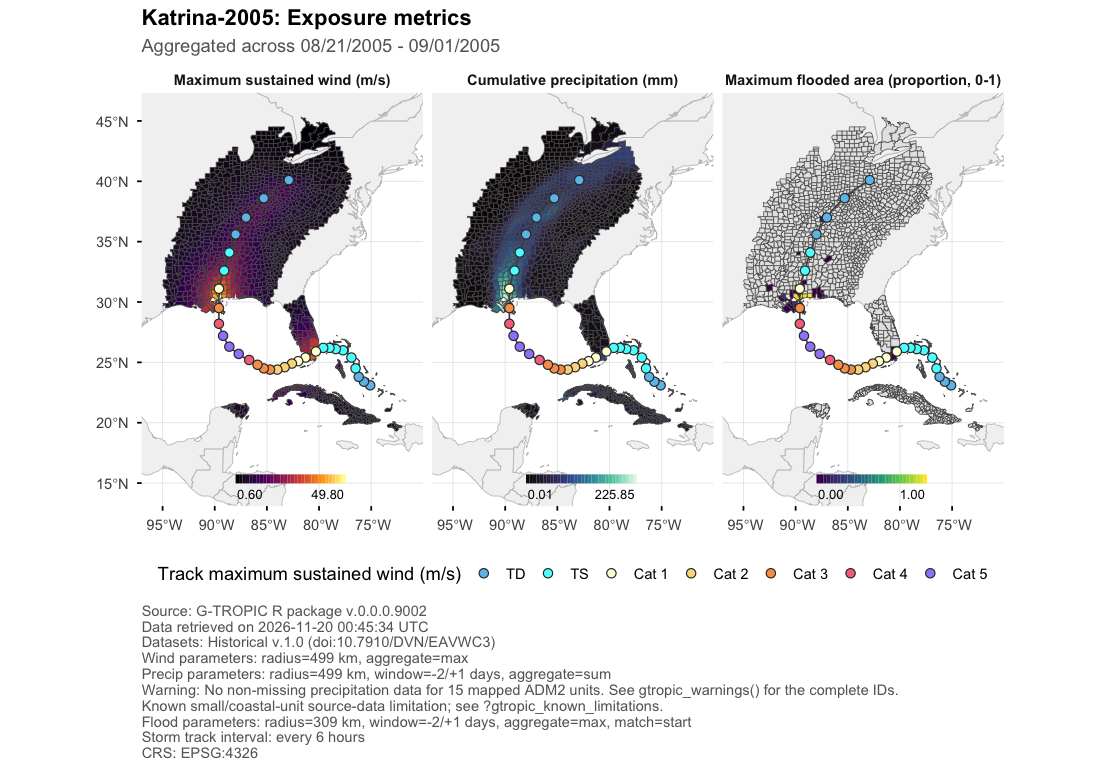
# Find and retrieve Hurricane Helene (2024) by its unique storm identifier
helene_matches <- gtropic_storms(STORM_NAME = "Helene-2024")
helene_matches
#> # A tibble: 1 × 4
#>   STORM_ID      STORM_NAME  USA_ATCF_ID STORM_GENESIS_DATE_UTC
#>   <chr>         <chr>       <chr>       <date>
#> 1 2024268N17278 Helene-2024 AL092024    2024-09-23
# This example has one match; if several appear, choose the intended row
helene_id <- helene_matches$STORM_ID[[1]]
helene <- gtropic_data(
  STORM_ID = helene_id,
  date_range = c(2024, 2024)
)
#> Discovering datasets in collection "gtropic".
#> Downloading 'metadata/adm2.parquet'.
#> Downloading '02_wind/storm_metadata/2024.parquet'.
#> Retrieving 10 files (175.3 MB) ; .
#> Downloading '02_wind/exposures/2024.parquet'.
#> Downloading '02_wind/zero_pairs/2024.parquet'.
#> Downloading '04_precip/2024.parquet'.
#> Downloading '03_flood/2024.parquet'.
#> Downloading '01_pop/2024.parquet'.
#> Downloading '02_wind/storm_tracks/2024.parquet'.
#> Downloading 'metadata/codebook.json'.
#> Downloading 'metadata/adm2_geometry_simplified.parquet'.

# Plot Helene's exposure data
gtropic_plot(helene)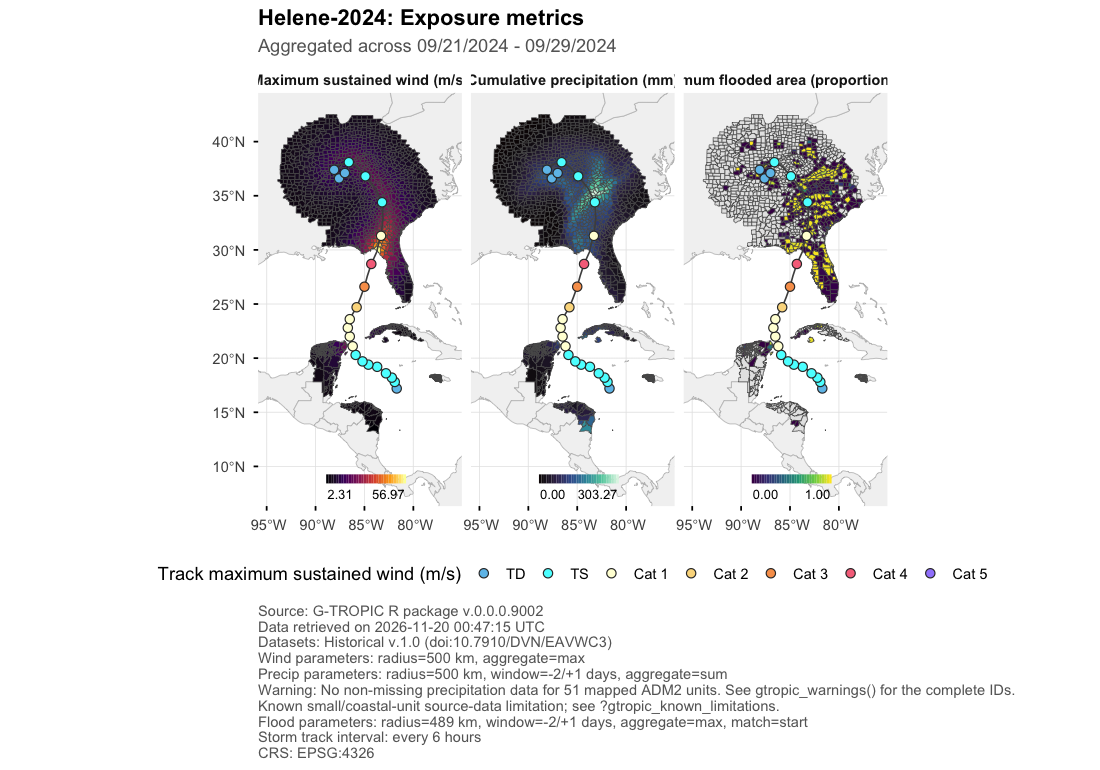
See vignette("plotting") for vectorized multi-metric maps, Saffir-Simpson track keys, gridlines, interactive maps, thresholds, and more.
Getting help
Extensive documentation is available on our pkgdown website as well as offline within R. You can see the gtropic reference manual in R with:
help("gtropic")A number of vignettes are available and can be browsed in R using:
browseVignettes("gtropic")We recommend reading the vignettes in the following order:
-
vignette("getting-started")introduces the cornerstonegtropic_data()function, running your first query, and how to navigate the resulting data. -
vignette("filtering")covers how all the spatio-temporal/storm filters ingtropic_data()combine, with a worked example. -
vignette("linkage")documents how to link precipitation/flood data to storm data and using thelinkstable to perform joins without double-counting exposure rows. -
vignette("plotting")covers static and interactive maps, vectorized options, and publication-ready output. -
vignette("versions-and-caching")walks through reproducibility and download management best practices ingtropic.
Citation
Please cite both the package and the underlying datasets. The dataset DOIs and versions used by any given result are recorded in its manifest:
gtropic_manifest(katrina)